Wednesday, January 13, 2016

Christian Universalism: Will Everyone Finally Be Saved?

When they are in fashion, fads are never recognized as fads.  Those under their influence and promoting them feel that they have come across An Important New Truth, or (if Orthodox) An Important But Neglected Part of Our Tradition.  Recognizing them as fads or, (worse yet for Orthodox) as deviations from genuine Tradition, would only serve to dismiss them from serious consideration.  Thus fads never  ’fess up.
            I suggest that the latest interest in Universalism, the belief that everyone will eventually be saved, is the latest fad (or, if preferred, that it is currently fashionable).  Evidence of this may be found in the fact that the view is being promoted by a number of different people who have little contact with one another and with little else in common.  Thus we find it promoted by a scholar such as David Bentley Hart in his essay God, Creation, and Evil, and also in more popular form (I am being polite), by Rob Bell in his best-seller Love Wins.  (My review of the latter may be found here.)  Admittedly the conviction that everyone will eventually be saved (including Satan and the demons) has been expressed from time to time throughout Christian history (as has the unrelated conviction that Christ is not fully divine), but, like the latter Arian opinion, the majority of Christians have decided to pass on it.  For people like the Orthodox who believe that God guides His Church and that therefore consensus matters, the solid fact of Christian consensus about the eternity of hell is surely significant.
            Orthodox scholars rarely stand on their hind legs and boldly proclaim that everyone will be saved.  Like Metropolitan Kallistos Ware, they simply ask “Dare We Hope for the Salvation of All?” (see his essay by that title in the anthology The Inner Kingdom), and then go on to answer, “Why yes, of course”.  Metropolitan Kallistos thus begins by declaring the question open (much like he recently declared the question of whether or not women may be ordained priests as open in the latest revision of his The Orthodox Church), and then proceeds to examine the evidence.  We will do the same here, and examine the Scriptures, the Fathers, and the teaching of the Fifth Ecumenical Council.  Since this is a blog and not a book, the examination must of necessity be somewhat limited.
            We begin with the Scriptures, and in particular with the Old Testament.  Most discussions I have read about this topic tend to ignore the Old Testament as irrelevant to the subject at hand, but given the fact that the apostles would have consulted the Hebrew Scriptures for all subjects, this seems unwise.  In the Old Testament we find the following consistent themes:
  1. God loves everyone, even idolatrous Gentiles such as those of Nineveh (e.g. Jonah 4:11);
  2. God hates sin and judges sinners (e.g. Psalms 11:5, 34:16);
  3. God judges sin with some reluctance, preferring the repentance of the sinner to his destruction (e.g. Ezekiel 33:11).
In all of these themes (the Scriptural citations for each could easily be multiplied) we see that although God loves everyone and judges with reluctance, He does nonetheless judge with severity those who persist in sin because He is implacably hates sin.  This binary theme of God as the lover of righteousness and hater of sin runs throughout the Old Testament.  God is the judge of all the earth, and His punishing judgment and severity falls upon those who rebel against righteousness.  Some might suggest that these themes have little ultimately to do with the subject of hell, since the judgment threatened in the time of the Old Testament had to do with this life and not the next.  Admittedly, the Old Testament texts do not deal much with the life of the age to come.  But there is one text that does:  Daniel 12:2, which declares that “many of those who sleep in the dust of the earth shall awake, some to everlasting life, and some to shame and everlasting contempt”.  The word rendered here “everlasting” is the Hebrew olam, which given its context of the age to come after the resurrection of the dead, means precisely “eternal” or everlasting in the traditional sense.  There is therefore no reason to think that the judgments of God upon the sinner have no application to the life of eternity. 
            The theme of the age to come of course comes to the fore in the New Testament.  And here, Christ speaks quite categorically:  the punishments of Gehenna are eternal.  He warns of the impenitent being bound hand and foot and cast into the outer darkness where men will weep and gnash their teeth (Matthew 8:12, 22:13, 25:30), and there is no suggestion that this punishment will be temporary.  Indeed, He teaches that in Gehenna, the “unquenchable fire”, the “worm does not die and the fire is not quenched” (Mark 9:43, 48).  If the Universalists are correct, then the worm will indeed die and the fire will indeed be quenched, but Christ here says the opposite.  In His parable about Lazarus and the rich man, Christ explicitly says that there is a great gulf fixed between paradise and the place of punishment, so that none may cross over from the place to punishment into paradise (Luke 16:26).  Granted that this is a parable and not a behind the scenes peak at eternity, it remains an odd thing to say if in fact everyone in the place of punishment will indeed eventually cross over into paradise.  Also important to the discussion is the fact that Christ describes the two fates awaiting men after the final judgment either as “eternal fire prepared for the devil and his angels”, and “eternal punishment”, or as “eternal life” (Matthew 25:41, 46).  Note that the same word “eternal” (Greek aionion) is used in v. 46 to describe both the eternal life of the saved and the eternal punishment of the condemned.  One can debate the meaning of the word aionion if one likes, but the word must have the same meaning in both halves of v. 46.  It cannot mean, for example, “the unrighteous will go away into age-long punishment, but the righteous into eternal life”.  If the life of the righteous is eternal, then so must be the punishment of the unrighteous.  One may assert that St. Paul proclaims universalism if one likes, but no one has ever suggested that Christ did.  All of His words about the fate of men in the age to come are emphatic that hell is eternal, and contain not a hint of universalism.  One cannot bypass this fact when promoting universalism, as many seem to do, but must rather explain why it is that Christ is so uncompromising in His words about hell.
            In his examination of the New Testament evidence mentioned above, Metropolitan Kallistos writes that “these and other ‘hell-fire’ texts need to be interpreted in the light of different passages from the New Testament which point rather in a ‘universalist’ direction”, by which he means “a series of Pauline texts”.  This is not so much using Paul as a lens through which to view Christ’s teaching as it is misusing Paul as a means of discounting the teaching of Christ, for if Paul indeed taught universalism, then Christ was simply wrong.  One cannot oppose Christ to His apostle like this and reject all of Christ’s teaching on hell simply because one prefers what one imagines is the teaching of Paul.  Obviously one must interpret both Christ and His apostle so that their teachings are mutually compatible.
            And in fact St. Paul does indeed conform with his Lord, and teach that the punishment of hell is unending.  Take for example 1 Corinthians 6:10 and Galatians 5:21, where Paul teaches that the unrighteous will not inherit the Kingdom of God.  There is no suggestion that actually they will inherit the Kingdom of God after all, but only after a lot of suffering.  Or take for example Ephesians 5:6, where he writes that the wrath of God comes upon the sons of disobedience.  If by “wrath” Paul meant only “temporary anger which will eventually give place to acceptance and bliss”, his warning loses most of its force.  Or take for another example 2 Thessalonians 1:9, where Paul describes the lost as “suffering the punishment of eternal destruction away from the presence of the Lord”.  If the banishment from the Lord’s presence were only temporary, it would hardly be eternal destruction.  As it is, it looks as if Paul is here echoing Christ’s teaching about the lost being bound hand and foot and cast into the outer darkness.
            And then there is the Book of Revelation.  This Book is clear to the point of being almost lurid that the pains of hell are unending:  “if anyone worships the Beast and its image…he also shall drink the wine of God’s wrath poured unmixed into the cup of His anger and he shall be tormented with fire and sulphur in the presence of the holy angels and in the presence of the Lamb.  And the smoke of their torment goes up forever and ever [Greek eis aionas aionon] and they have no rest day or night” (Revelation 14:11).  The devil and his angels, far from being eventually redeemed because love wins, will be “thrown into the lake of fire and sulphur…and they will be tormented day and night forever and ever” [Greek eis tous aionas ton aionon] (Revelation 20:10).  If the words eis aionas aionon does not here mean “unending”, then words have no meaning.  Indeed, if a man wanted to express the concept of unending punishment, how much more emphatic than this could he get?  One may, if one likes, presume to be more loving and tender-hearted than the apostolic author of these words.  One may lament the fate of the lost, while condemning those who believe that hell is eternal as heartless and insensitive members of a “hellfire club”, but of the author’s intent in writing those words there can be little doubt:  the punishments of hell are unending and eternal.  How such a view can be moral and consistent with belief in a loving God can and should be debated.  But for Christians who believe the Scriptures, the truth of this teaching is sure.  Our faith must be rooted in the Scriptures, not in our own views of whether or not we think something is consistent with love as we understand it.  A belief in hell may or may not be consistent with love, but what is certain is that it is taught in the Scriptures, and this must be the deciding factor for us.  The upshot of all this may be summed up by John, the beloved disciple and the apostle of love:  “he who does not obey the Son shall not see life, but the wrath of God abides upon him” (John 3:36).
            Since this teaching about the eternity of hell is so unambiguous, Paul’s other words (which everyone acknowledges contain more ambiguity) must be interpreted in the light of them.  In 1 Corinthians 15:28, for example, Paul teaches that at the end, all will be subject to God, so that He “will be all in all”.  In its context, it is doubtful if this means more than simply all of God’s enemies including death (the main subject of the chapter) will be destroyed, and in the new heaven and new earth, righteousness will finally reign (compare 2 Peter 3:13).  This is compatible with the lost no longer being found in the new heavens or the new earth, but in the darkness outside, excluded from the Kingdom (compare Matthew 13:41-43, 25:30). 
In other passages Paul writes that just as Adam’s sin brought death to all men, so Christ’s work brought justification and life to all (Romans 5:18), and that “as in Adam all die so in Christ all will be made alive” (1 Corinthians 15:22).  Here Paul is speaking of the possibility of all men enjoying eternal life, not of the certainty of their eventual salvation.  Paul teaches here that in Christ all have been made alive, and their redemption has been purchased—but whether one chooses to be and to remain “in Christ” depends upon their personal choice.  According to Paul, life has indeed come to all, but that life is in God’s Son.  No one will enjoy this life unless one is in the Son, “in Christ” (to use Paul’s term) and unless one remains in Him “stable and steadfast, not shifting from the hope of the gospel” (Colossians 1:23). Christ is truly the Saviour of all men (1 Timothy 4:10), but for men to be enjoy that salvation, they must believe, otherwise they will be condemned.
In perusing the New Testament teaching, John’s gospel in particular, along with his epistles, shines not only with a universal offer of salvation to all the world, but also with this fundamental binary approach—the choice between light or darkness, faith or unbelief, salvation or condemnation.  For St. John the key to enjoying this salvation is acceptance of Jesus as Lord and God.  John is emphatic that Jesus came to save the whole world, and equally emphatic that a man must believe in Jesus to be saved.  Thus “he who has the Son has life”, while “he who has not the Son of God has not life” (1 John 5:12). Universalism destroys this fundamental apostolic binary.  A view of history as one of eternal cyclic return—of all the cosmos falling and then eventually returning to saving unity—might have resonated for many in Origen’s day and inspired his own view of apokatastasis, but it is alien and incompatible with the Hebrew and binary approach to life and salvation found in John’s Gospel, and in the rest of the New Testament.
            We turn now to a brief look at the Fathers.  Here is not the place to enter into a detailed examination of what these ancient Christian writers wrote, and what they meant by it, and whether they would be happy to be thus hauled into court as witnesses for Christian universalism.  In the case of Origen, we may doubt this last:  he said that although all will be saved, this teaching ought to be kept secret, and shared only with the spiritually mature.  Presumably this excluded promoting this teaching on blogs.   
            In the vast array of the Fathers, only a few are regularly cited:  Gregory of Nyssa (along with his mentor Origen), and Isaac the Syrian.  We note in passing that some have debated whether or not Gregory of Nyssa may be considered a universalist in the sense we are discussing.  Metropolitan Hierotheos Vlachos argues in his book Life After Death that Gregory of Nyssa did not in fact contradict the view of the Fifth Ecumenical Council that the punishments of Gehenna were unending.  Where such scholars disagree about patristics, I am happy to walk away quietly and leave the question open.  But even if Gregory of Nyssa did actually teach that all will be saved, his was still simply a single individual opinion.  It could be, as some suggest, that many other Fathers have written from a universalist perspective.  Being a parish priest and not a patristic scholar, I have not read everything written by the Fathers, would be happy to hear their voices, especially set in context, finding out in which book or essay they wrote their universalist opinion.  But that Gregory of Nyssa and Isaac the Syrian are the only ones constantly quoted by proponents like Ware and Hart does little to bolster the view that many of the Fathers thought like this.  One always hears about Gregory and Isaac, and hardly ever about anyone else.  It is difficult to not to conclude that Gregory (with his mentor Origen) and Isaac the Syrian and few others stood over against the vast consensus of practically everyone else.   
            At the risk of opening up a game of duelling patristic citations, in the east one might quote from St. John Chrysostom:  “There are many men, who form good hopes not by abstaining from their sins, but by thinking that hell is not so terrible as it is said to be, but milder than what is threatened, and temporary, not eternal… But that it is not temporary, hear Paul now saying, concerning those who know not God, and who do not believe in the Gospel, that ‘they shall suffer punishment, even eternal destruction.’ How then is that temporary which is everlasting?”  (from his third homily on 2 Thessalonians).
            Then in the west we may quote from St. Augustine of Hippo:  “I am aware that I now have to engage in a debate with those compassionate Christians who refuse to believe that the punishment of hell will be everlasting…On this subject the most compassionate of all was Origen, who believed that the Devil himself and his angels will be rescued from their torments and brought into the company of the holy angels…But the Church has rejected Origen’s teaching…Is it not folly to assume that eternal punishment signifies a fire lasting a long time, while believing that eternal life is life without end?  For Christ, in the very same passage, included both punishment and life in one and the same sentence when He said, ‘So those people will go into eternal punishment, while the righteous will go into eternal life’”  (City of God Book 21, chapters 17, 23).
            In this last citation we note that Augustine asserted that “the Church has rejected Origen’s teaching”.  He appears to refer to an existing consensus, which rejected the apokatastasis taught by Origen.  This consensus would later come to be expressed in the canons of future Ecumenical Councils.  The views of the Fathers are important, but perhaps not as important as the traditions of these Councils, for an Orthodox thinker may disagree with St. Augustine or St. John Chrysostom, but he may not disagree with the conclusions of the Ecumenical Councils and still regard himself as genuinely Orthodox.  This is not a matter of “rigorism” or being exclusionary, but simply a matter of recognizing the normative authority of the Ecumenical Councils for those claiming to be Orthodox.
            When we look at the Fifth Ecumenical Council, we find associated with it a series of fifteen anathemas directed as heretical teachings of that day associated with the name of Origen.  Though no one doubts Origen was condemned by the Council (his name was included along with Arius, Eunomius, Macedonius and other ancient heretics in Canon 11), considerable doubt attaches to whether the fifteen anathemas were the genuine work of the Council.  Some suggest that they were the work of bishops meeting before the Fifth Ecumenical Council.  Either way, the Council Fathers certainly knew of them and approved of them (as even Metropolitan Kallistos acknowledges), since they condemned Origen by name, lumping him in with other ancient heretics.  These anathemas therefore may be allowed to stand as illustrative of why the Council Fathers anathematized Origen in Canon 11.  (These anathemas were confirmed by the first canon of the “Quinisext Council” held in 692, which spoke with approval of how previous Council Fathers “anathematized and execrated…Origen”.)
            Origen of course produced much good work in his day (St. Gregory the Theologian referred to him as “the whetstone of us all”), but much of his speculation was later deemed erroneous and heretical.  The abiding point of the anathemas therefore has to do with Origenism as it was known in the sixth century with its erroneous teachings, and less to do with the historical figure of Origen himself.  What was it that the Church was determined to anathematize?  We gain some idea from looking at the fifteen anathemas themselves.
            The first one anathematizes anyone who “asserts the fabulous [i.e. mythical] pre-existence of souls”.  The fourteenth anathema rejects the teaching that “all reasonable beings will one day be united in one when hypostases as well as the numbers and the bodies shall have disappeared…and that in this pretended apokatastasis spirits only will continue to exist”.  Clearly the doctrine of apokatastasis considered here appears in Origenistic dress.  But would the Council Fathers have been much more accepting if the doctrine appeared without Origen’s teaching of the pre-existence of souls and their eternal return?  St. Augustine would not have been much mollified, nor St. John Chrysostom.  Nor would Justinian, who called the council: one of his nine anathemas against Origen reads, “If anyone says that the punishment of demons and of impious men is only temporary, and will one day have an end, and that a apokatastasis will take place of demons and of impious men, let him be anathema”.  It is possible, I suppose, that although the Emperor seems to have rejected the notion of apokatastasis in principle, the Council Fathers accepted it in principle, and only anathematized it because of its Origenistic framework, but this seems a bit of a stretch.  If the Council Fathers had no problem with apokatastasis as such, one wonders why they mentioned it at all in their condemnation of Origen.  At least they could have made clear that it was Origen’s use of the teaching that they found objectionable, and not the teaching itself.  It all reminds me of the special pleading of John Henry Newman, who argued in his Tract 90 that the 39 Articles (then considered authoritative for Anglican clergy) did not condemn the doctrine of purgatory in principle, but only “the Romish doctrine concerning purgatory”, when clearly the framers of the 39 Articles would have little sympathy for any doctrine of purgatory at all.
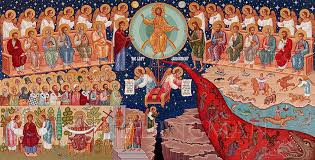
            At the end of the day what ultimately matters is less the historical minutiae of the Council’s background (fascinating though it may be to scholars) than the abiding consensus of the Church through the centuries--a consensus reflected not only in the Church's iconography regarding the Last Judgment, but also in her hymns.  Consider, for example, the stich for the Vespers of the Sunday of the Last Judgment:  "the whole vale of sorrow shall echo with the fearful sound of lamentation, as all the sinners, weeping in vain, are sent by Your just judgement to everlasting torment".  The Church later read the Council as condemning not only Origen’s teaching in particular, but also as condemning the concept of an ultimate apokatastasis in principle.  One may lament this reading of the Council (as some do) and spend much effort trying to correct it and promote universalism as a live option (perhaps even rehabilitating Origen).  But surely an age-long Orthodox consensus has a weight of its own?  For centuries Orthodox Christians have believed that the doctrine of an ultimate apokatastasis was off the table, and this cannot be ignored.  It is a narrow and legalistic reading of our tradition that that ascribes authority only to the pronouncements of the Ecumenical Councils, as if everything not explicitly condemned by them were live options.  Liberal scholars, of course, are happy to dismiss centuries of tradition and belief as the ramblings of the ignorant and uneducated, but pious Orthodox will give this tradition its due weight.  And when the Scriptures are so clear, and when the consensus of the Fathers so weighty, and when the occasions when the Ecumenical Councils which considered the question all point in the same direction, we may conclude that we have found the mind of the Church.  We live in a day when much of Holy Tradition is being challenged in the Church, and many questions which were considered closed are now being considered open.  It is not surprising, therefore, if the Church’s condemnation of the apokatastasis is among them.
            It remains to consider the question:  if a desire to rehabilitate a belief in the apokatastasis is indeed a fad, why does it arise in our culture now?  A full response cannot be attempted at the end of an already over-long article.  But I think that is not unrelated to our culture’s loss of its sense of sin.  As mentioned over a century ago by C.S. Lewis, the modern West has lost its sense of sin.  In ancient times, all men, be they Jew, pagan, or Christian, believed that they stood guilty before the divine judgment seat.  That is not to say that there was no cause for theodicy, but at very least one felt shame for one’s own sins.  Thus when Christ said in passing that men were evil [Greek poneros; Matthew 7:11], no one batted an eye, for everyone knew it was true.  We no longer believe that, and so (in Lewis’ famous phrase) we have put God in the dock, with ourselves as His judges.  In this frame of mind the very existence of hell is a stumbling block, and something which cries out for justification, if not revision.  There is a place for considering and explaining how the existence of hell is consistent with God’s love.  But we set ourselves up to err if we do not first feel the shame for our own sins, and proceed from there.
                       
Next:  The Morality of Gehenna

Monday, January 4, 2016

Fire in the Desert

The Sunday before the feast of Theophany is dedicated to the work of John the Baptist (or St. John the Forerunner, to give him his liturgical title).  To appreciate him fully, we need to place him in his historical context, and realize that he came to Israel as a thunderstorm at the end of a long drought.  Or, to vary the metaphor, as a fire in the desert, illumining the darkened hearts of men.
            It had been a long time since the voice of prophecy had sounded in Israel.  Though holy writing had never ceased (the Book of Sirach, for example, dates from the second century B.C.), no prophet had arisen to proclaim the Word of the Lord since Malachi lifted up his voice in about 430 B.C.  Since that time Israel had endured the tyranny of Antiochus Epiphanes who desecrated the Temple, the rise and internecine strife of the Hasmoneans, and the coming of the Romans, under whose Imperial boot they remained firmly lodged.  A modern proverb says, “When you come to the end of your rope, tie a knot and hang on”.  By the time of John’s birth, Israel had come to the end of its rope.  They therefore tied a knot and hung on, and the knot unto which they clung was the Law, with its hope of final Messianic liberation.  Hope deferred, the Scriptures tell us, makes the heart sick (Proverbs 13:12), and many had grown discouraged and sick of heart in waiting for the seemingly eternally-deferred hope of redemption.  In response Zealots arose in Galilee to use terrorist tactics to force God’s hand.  Pharisees buried their heads in the Scriptures and debated its details.  The common people just waited with heads hung low, and wondered quietly in the wee hours of the night if their God had abandoned them.
            Then came the voice of John sounding like a trumpet in the wilderness:  “Repent, for the Kingdom of heaven is at hand!”  In the darkness that hung over men’s hearts in that day, the fire of his words came like a light, and all Israel lifted up their heads, and looked to the desert with new hope.  John proclaimed that Messiah was at hand, but that Israel was no more ready to receive redemption than were the godless Gentiles.  They must therefore repent, and wash away their sins just like Gentiles did when they were baptized and became Jews. Some questioned John’s authority to baptize Jews as if they were Gentiles.  Who did John think he was?  Was he Elijah, they demanded?  Was he Messiah himself?  No, none of these.  What was he then?  A voice—just a voice.  A voice crying in the wilderness, prepare the way of the Lord; make His paths straight.  Did they object to him baptizing in water?  One would soon be among them who would baptize with fire.
            John’s voice continues to sound telling us to open our eyes.  Like Israel in John’s day, we remain blind, shrouded in darkness.  We need to see with new eyes, and look again at the world around us.  
            That is, we need first of all to look to our hearts.  This is the meaning of repentance—to look first at the darkness within us, and let in the light of God.  When the light shines in we will see that God is not simply one part of our life, but life itself.  Our modern secular society has banished God from its culture, and relegated religion to a single, hermetically-sealed compartment of life (preferably kept far and at a safe distance from the public square).  We are surprised when we learn that in previous centuries (and in Islamic lands today) the awareness of God permeated everything.  To live was to walk in the presence of God, dwelling beneath His shadow.  Our culture today regards such a life as fanaticism, but for ancient societies (and for John) this was simply normal living.  They were not the fanatics.  It is we who are mad.
            Secondly, we need to look to our neighbour, and see him for what he is—that is, as God’s gift to us.  We often do not see our neighbour.  Those around us are two-dimensional, people without names, histories, hopes, or sorrows.  Do we know the name of the person who serves us coffee every day at Starbuck’s?  Do we know the name of the person in the street to whom we give spare change?  For most of us, these people are not real, and we hurry past them as if they were phantoms.  John the Forerunner reminds us that those whom we meet even casually are people like us, and if we have two coats, we should give the second one to the one who has none (Luke 3:10-11).
            Finally, we need to look to the horizon.  John bid the people look not the darkness filling the land (which often bore a Roman sword), but to the coming Kingdom of God.  We live in a later day than John, and the Lord before whom he ran has already come and established the Kingdom of God like seed in the earth.  The horizon to which we look is lit with the light of His Second Coming.  The land is still filled with darkness, reported duly by CNN and Fox network and a thousand other shrill voices of despair.  Like those who first heard John crying in the wilderness, we look up with hope.  The prophetic voice of the Old Covenant ended with Malachi calling them to wait for the day of the Lord that would come burning like a furnace and for the Sun of Righteousness who would arise with healing in His wings (Malachi 4:1-2).  The prophetic voice of the New Covenant ends with the voice of St. John crying, “Come, Lord Jesus!” (Revelation 22:20).  In both Old Testament and New, the horizon is the place to look to.  For at all times it is illumined with the light of redemption and victory.

Tuesday, December 29, 2015

Christ As Hierophant

Every Sunday our little parish serves an abbreviated Matins service before the Divine Liturgy, and part of that service contains a hymn called an “Exaposteilarion” or “Song of Light”.  In the Sunday Matins, it consists of a brief meditation upon the Gospel reading narrating one of Christ’s Resurrection appearances.   In one Song of Light we read the following:
“At the sea of Tiberias, Thomas was fishing with the sons of Zebedee, Nathaniel, Peter, and two other disciples of old. Casting to the right at the command of Christ, they caught a multitude of fish. And Peter, recognizing Him, cast himself into the water. This was the third time He appeared to them and He showed them bread and fish upon the coals.”
            Every time I heard this I wondered what could be the significance of Christ showing them bread and fish upon the coals.  Note:  the hymn-writer doesn’t say that Christ provided a breakfast of bread and fish (though of course He did), but specifically that He showed them bread and fish.  This act of showing clearly seems to have been important to the hymn-writer, but I could never figure out why.
            That is, until I read recently about the important office of hierophant in the ancient world.  In the Mystery religions, anyone wanting to participate in the sacred and saving Mysteries (for example, the Mysteries of Dionysius the wine-god or those of Demeter the fertility goddess, founder of the famous Eleusinian Mysteries) had a secret initiation which culminated in being shown secret cult objects.  The person in charge of these objects of mystical significance was called a “hierophant”, literally a “sacred show-er”, someone whose task it was to show to the initiate the sacred cult objects.  It occurred to me that a Byzantine Christian hearing the Song of Light’s reference to Christ showing His disciples bread and fish would have instantly thought of the work of a hierophant.
            But what then was the significance of these sacred objects, and what was the point that the hymn-writer was trying to make?  Simply this:  that in beholding the fish and the bread, the disciples were being initiated into the Eucharistic mystery of the Church.  When they saw the fish and the bread lying there upon the coals, they were being told that henceforth all their Eucharistic meals would be hosted by the risen Christ, and as they ate the fish and bread with Him there by the sea of Tiberias, so henceforth they would eat the Eucharist with Him every succeeding Sunday.  From at least the days of catacomb art, the Church’s Eucharist was symbolized not by bread and wine (as one might perhaps expect), but by bread and fish.  The multiplication of the loaves and the provision of bread and fish for the multitudes became for the Church an image and foreshadowing of their own festal meal, especially since after the multiplication of the loaves Christ gave His teaching about eating His flesh and drinking His blood (John 6).

            We need to remember this every Sunday when we gather for the Eucharist.  We may think that the person presiding over the meal and mystery is the one we see with our physical eyes—namely, the priest standing at the altar.  But that is not so.  The real host of the meal is the risen Christ, the One whom we see invisibly with the eyes of faith.  He provided a meal of fish and bread for His disciples that cold and fresh morning by the sea of Tiberias after a long and fruitless night of fishing.  He provides a similar meal of Eucharistic bounty and grace for us now every Sunday morning.  It is okay that we come to that meal tired, and sinful, and empty, and needy.  We also have fished all night and caught nothing.  His word to us is the same as it was to them:  “Come and have breakfast” (John 21:12).  Christ provides a meal which fills and warms us, and we eat with Him in the light of a new resurrection morning.

Wednesday, December 9, 2015

Islamophobia

          With an admitted abundance of irony, I find myself phobic about the use of any word that ends in “phobic”, largely because the word is usually used to shut down sensible sustained debate, and functions as a kind of rhetorical club in the hands of ideological bullies.  Take the popular word “homophobic” for example.  The word is used as a label to denounce and silence anyone arguing that homosexual practice is sinful.  Those in favour of the moral legitimacy of homosexual practice now do not need to effectively reply to arguments that it is sinful.  They need only denounce the opponent as “homophobic” and that is the end of it.  The vanquished homophobe is supposed to slink away and vanish into the mists of history, taking his place alongside Nazis, White Supremacists, and those asserting that the world is flat.  It is nonsense, of course, and I suppose that anyone can play the game.  I might coin the term “Christianophobic” (unless someone has beat me to it?) to describe anyone opposing Christian dogma and history, and use the label to defend everything that was ever done by the Church.  Do you deny that Jesus is divine?  How Christianophobic of you.  Tempting, I suppose, except that our commitment to truth means we are also committed to civil and reasoned debate, and to deciding every argument on the basis of its actual merits.  No ad hominem shortcuts allowed, however useful.
So, I find that I approach the word “Islamophobia” with some trepidation, but current events require some sort of response from Christian teachers, and one cannot talk about what is going on without recourse to the word.  I refer especially to Mr. Donald Trump’s recent suggestion that America ban future entry of all Muslims “until our country’s representatives can figure out what the hell is going on”.  This last bit seems a bit vague, but I suppose it means something like “until our country’s representatives can be sure that no Muslim seeking entry will ever act violently”.  Given the amount of non-Islamic violence sweeping America and making the news, this seems to set the bar unfairly high for Muslims, but that is not my point here. The larger issue, pushed to the fore by Mr. Trump, is the question of whether or not Islam is inherently violent, and we must address the issue on its own merits.  Sometimes Muslims, feeling that they are under attack, react with the single response, “You’re being Islamophobic!” and try thereby to shut down the discussion.  I can understand such a defensive response, especially when Muslims are indeed sometimes victims of real prejudice, but we still need to keep the dialogue going.
            In examining this question, it is crucial to distinguish several things.  I would therefore like to distinguish between: 
1. Muhammad’s practice and the text of his Qur’an;
2. the history of subsequent Islamic expansion in the decades and centuries following his death in 632;
3. the practice of Muslims throughout the Islamic Empire and in the Middle East;
4. liberal Muslims today; and
5. Islamists. 
Unless these five things are distinguished, we cannot get very far in understanding our Muslim neighbours and making sense of the world today.  Of course if one’s aim is not to work with complexities but simply to inflame voters, then such understanding is not required.  In beginning to examine the question of violence in Islam, we begin with:

1. Muhammad’s practice and the text of his Qur’an.  It seems clear enough that Muhammad had no problem with using violence and warfare to protect, sustain, and expand the progress of his new religion, especially after his flight to Medina.  We think of his slaughter and decapitation of about 700 prisoners of the Jewish tribe of the Bani Quraiza.  One could multiply examples, but no one disputes Muhammad’s use of warfare and violence to spread his religion.  This acceptance of violence in the service of religion is found in the Qur’an also.   Take, for example, surah 2:190f:  “Fight for the sake of Allah those that fight against you, but do not attack them first.  Allah does not love the aggressors.  Kill them wherever you find them.  Idolatry is worse than carnage.  But do not fight them within the precincts of the Holy Mosque unless they attack you there; if they attack you, put them to the sword…Fight against them until idolatry is no more and Allah’s religion reigns supreme.  But if they mend their ways, fight none except the evil-doers.”  Or, take another example, surah 9:123:  “O believers, fight the unbelievers who dwell around you and let them find hardness in you.  Know that Allah is with the righteous.”
          Some modern liberal Muslims contextualize these verses and assert that they have relevance only to the time of Muhammad when his young religion was under threat, and should not be applied today.  That is certainly one way to read those verses, and in fairness, that is how we Christians read the verses in the Book of Joshua about (for example) the slaughter of the people of Jericho in Joshua chapter 6.  Joshua and his armies engaged in violence and genocide, but no one today regards these historical facts as setting a precedent which would allow modern Christians (or Jews) to spread their faith with the sword.  The question is therefore whether or not Muhammad’s example and his Qur’anic verses offer a paradigm for Muslims in later ages, or whether they should be regarded solely as an historical “one-off”.  The question may be partially answered by looking at:

2. The history of subsequent Islamic expansion.   When we examine the history of Islam in the years, decades, and centuries after Muhammad’s death in 632 A.D. we see that his followers did indeed seem to regard both his personal example and the Qur’anic verses about warfare (or jihad) to be paradigmatic.  His successor Omar conquered Damascus in 635, and Jerusalem in 638.  The great city of Alexandria was conquered in 640 and Muslim armies continued their outward military push, entering Spain in 711.  The year 732 brought them almost to the gates of Paris, where they were repelled by Charles Martel.  Sicily was invaded in 827 and finally conquered in 902.  Constantinople was repeatedly assaulted, although it did not fall until 1453.  By no stretch of the imagination can these wars be considered as merely defensive.  If Islam in the years following Muhammad’s death regarded his example merely as historical (as Christians regard the wars of Joshua) why did they continue to follow his example?  We come now to:

3. The practice of Muslims in the Islamic Empire and the Middle East, and here we do indeed see a measure of comparative tolerance.  But only a measure, regardless of what Islamic apologists (both Muslim and Western) might suggest, for the non-Muslim populations of Islamic lands were still distinctly second-class.  The official designation for such enforced second-class status was dhimmi—they were “a protected people”, and ostensibly free from harm so long as they kept to their place and paid the required tax.  The practice of treating non-Muslim inhabitants in this way was justified by the Qur’an, surah 9:29:  “Fight against such who do not believe in Allah even if they are People of the Book [i.e. Christians or Jews] until they pay the tribute [Arabic jizya] with willing submission and feel themselves subdued.” 
Though the Islamic tolerance shown to religious minorities did not approach modern standards of pluralism, it must nonetheless be judged by the standards of its own time, not by ours.  Tolerance of religious minorities did not thrive much anywhere in Europe either, as our Jewish friends are quick to remind us, and between the practices of the Islamic Empire and Christendom there was perhaps not much to choose.  Yet even in these debased circumstances, Christians and Jews still could find social advancement in Muslim societies—the father of St. John of Damascus, for example, served in the civil administration of the Caliph in Damascus.  And prior to the establishment of the State of Israel in 1948, Muslims, Christians and Jews managed to coexist peacefully in the land of Palestine.  Evidently an empire is a big thing to run, and Muslim rulers discovered that a certain amount of diplomacy and tolerance was necessary to grease the Imperial wheels and keep things running smoothly.  As the heirs to this fragile tradition of co-existence we find many Muslims today for whom Islam is indeed a religion of peace and who are quite happy to practice their faith within a pluralistic Western setting.  These people I refer to as:

4. Liberal Muslims.  Some suggest that these Muslims are not so much liberal as Westernized, and that the liberalism and tolerance they profess come not from their Qur’an as from an adoption of western Enlightenment values.  They would disagree, and point to such Qur’anic verses as surah 2:256:  “Let there be no compulsion in religion”.  They also point to such classical Islamic teachers as Averroes (the Latinized form of Ibn Rushd) who promoted a twelfth century defense of Aristotle and the supremacy of reason.  Muslims like Bassam Tibi (in his invaluable work Islamism and Islam) certainly assert that one can be authentically Islamic while still embracing the values of a liberal democracy.  But whether their tolerance, pluralism, and genuine love for democratic values spring from Islam or from the West, there is no doubt that many millions of them share the values of our liberal western democracy.  The problem with asserting that all Islam is inherently violent and (for example) forcing all American Muslims to be registered is that this would penalize those peaceful fellow-citizens for the sins of others.  Such penalizing would ironically reduce Muslims in America to the debased status of a dhimmi, so that non-Muslim Americans would reproduce the very social realities they criticize in classical Islam.  The religion many American Muslims practise is clearly a religion of peace.  Is it our place as non-Muslims to define Islam for them?  These liberal Muslims are to be distinguished from what are sometimes called:

5. Islamists.  All Islamists are Muslims, but most Muslims are not Islamists.  An Islamist is defined by his or her desire to establish an Islamic State, wherein a re-invented form of sharia law allows the state to function as a new totalitarianism.  This is forcibly argued by Bassam Tibi (in his book mentioned above).  In Islamist thought, the Jews are responsible everything terrible in the world (including, believe it or not, the Crusades), and are waging war against a besieged Islam.  In this delusional world the infamous Protocols of Zion, which outline a global Jewish conspiracy, are accepted as genuinely historical.  The Islamists declare that Islam is under global threat, and so must defend itself.  Some Islamists openly advocate terrorism (as a redefined jihad); other Islamists renounce terrorism, striving to establish the Islamic State through the mechanisms of democracy and the ballot box.  Their methods differ, but their goal is identical, and after the totalitarian Islamic State is established, all Islamists agree that free elections will be a thing of the past, having been replaced by sharia, which they consider as the reign of God on earth.  Politically-correct assertions that terrorists as “non-Islamic” or as “anti-Islam” are nonsensical, for the Islamists are motivated by genuinely religious motives.  Saying that Islamists are “not Islamic” is like saying that Nazism was “not German”.
            In this Islamist vision of the world, Islamism equals Islam, and true Islam contains all the violent and totalitarian features of Islamism.  This is why the Islamophobia promoted by Mr. Trump is genuinely dangerous, for here he agrees with the Islamists that Islam equals Islamism, and is thereby pushing liberal Muslims into the Islamist fold.  The Islamists contend that Islam is under threat from the West, and that true Muslims should renounce the values of liberal democracy as un-Islamic.  What better way to prove their point than by persecuting western Muslims?  The liberal Muslims regard themselves as full partners in western democracy and their practice of Islam as fully consonant with this.  They distinguish their version of Islam from that of the Islamists.  If America demonizes Islam by denouncing it as always inherently violent, refuses entry to all Muslims worldwide, or makes moves to register its Muslim citizens, what could liberal Muslims conclude but that the Islamists were right all along?  Mr. Trump would prove himself to be the greatest radicalizer of Muslims in all the world.  What Islamist propagandists could not do, Mr. Trump would do for them.  A better path would be to welcome the liberal Muslims as our best partners in dialogue and to share the full fruits of citizenship with them.  Part of this dialogue of course will involve unmasking Islamism in all its forms for what it really is.

            The question “Is Islam inherently violent?” must be answered with another question, “Which Islam?”  The Islam of Muhammad and his early successors was certainly violent.  The Islam of the Islamists is certainly violent.  The Islam of many liberal Muslims today is not.  Which kind of Islam will become predominate in the Muslim world in the future is a question only the Muslims themselves can answer.  The West would be well advised to help the liberal Muslims of the world push for a transformation of classical Islam so that it is their peaceful and pluralist version of Islam which wins the Islamic day.

The take-away for Christians is this:  the Muslim down the street is our neighbour and a soul for whom Christ died.  That means that we must love him and affirm the truth that he has, as well as sharing humbly the truth of Christ that he does not yet possess.  St. Paul did this with the pagans of his day, and won them for the Lord.  We must do the same with our Muslim neighbours today.